Military Bulletin 07/2015 – Russian nuclear missile drills.

At the beginning of June, Russia initiated a number of large-scale drills for its Strategic Missile Forces. Fifty regimental and ‘special tactical’ exercises, some lasting more than a month, involving rapid deployment and break-out to field positions will continue, unannounced, throughout the year. This will involve 30 missile regiments along with their associated mobile missile systems.

At least a third of the exercises will be surprise drills, and they will involve combat training with security and defence units. Additional ‘special tactical’ exercises, twenty in total, will also be conducted involving biological warfare defence training. It is thought that ten types of biological weapons and toxic agents will be simulated, including anthrax, plague and Ebola.

imageTopol-M TEL (Transporter, Erector & Launcher), Russian Intercontinental Ballistic Missile. NATO reporting name SS-27 ‘Sickle B’. Speed Mach 22 (26,000+kph), range of 11,000 kilometres, carrying a 800 kiloton warhead.

Below is the SS-27 Mod2, a Russian (Multiple Independently targeted Reentry Vehicle) MIRV-equipped thermonuclear weapon intercontinental ballistic missile. It is believed that it can carry up to 10 MIRVs. At least 4 MIRVs, each carrying 100-300 kiloton warheads. It has a speed of Mach 20 (24,500 kph) and a range of 11,000 kilometres.

.

PC-24_«Ярс»-2

The RS-24 Yars, NATO reporting name of SS-27 MOD

“PC-24 «Ярс»” by Соколрус – Own work. Licensed under CC BY-SA 4.0 via Wikimedia Commons 

This is all part of Moscow extensively testing its ‘triad’ nuclear arsenal, submarine launched ballistic missiles, silo-based intercontinental missiles and its long-range strategic bombers. General Sergei Karakaev, commander roof the Russian Strategic Missile Forces, has been quoted as saying ‘the exercises will guarantee the highest degree of combat readiness and break-out capabilities, and of fighting in different environmental conditions, including an NBC (Nuclear, Biological and Chemical) environment.

The Bear continues to growl…..

Post copyrighted to Harvey Black


Military Bulletin 06/2015 – Soviet Submarine Fleet

There is a lot of talk about the demise of the Russian Submarine Fleet, but one still exists and is still very powerful. Split into Strategic and Tactical, the Russians currently have:

Strategic SSBN

3 x Kalmar (Delta III), each carrying 16 R-29-R Volna (SS-N-18 stingray) strategic Submarine Launched Ballistic Missiles (SLBM)

6 x Delfin (Delta IV), each carrying 16 R-29RMU Sineva (SS-N-23 Skiff) strategic SLBM (One has just returned from repairs)

1 x Akula (Typhoon) in reserve for training with the capacity for 20 Bulava (SS-N-X-32) SLBM. (trials/testing)

2 x Borey with capacity for 16 Bulava (SS-N-X-32) SLBM (missiles not yet operational). One additional vessel expected 2014/2015.

.

K-535_Yuri_Dolgorukiy_at_sea_trials

K-535 Yuri Dolgorukiy, Borey-Class, at sea trials

“K-535 Yuri Dolgorukiy at sea trials” by Schekinov Alexey Victorovich – Own work. Licensed under CC BY-SA 3.0 via Wikimedia Commons 

Tactical

SSGN

8 x Antyey (Oscar II) (of which three are in reserve or repair). each has 2 x 12-cell launcher with 3M45 Granit (SS-N-19 Shipwreck) Submarine Launched Cruise Missile (SLCM) Anti-ship missiles (AShM). 2 single 650mm Torpedo Tubes (TT) each with T-65 HWT. 4 single 553mm TT.

1 x Yasen (Graney) with one Octoupule Vertical Launch System (VLS) with 3M55 Onyx AShM; 3M14 Kalibr (SS-N-30) SLCM; 8 single 533mm TT.

SSN

Russia also has 17 Nuclear attack submarines, SSN, consisting of the following types:

2 x Schuka-B (Akula II)

8 x Schuka-B (Akula I)

2 x Kondor (Sierra II)

1 x Barracuda (Sierra I)

4 x Schuka-B (Victor III)

SSK

The Russian navy has 21 x SSK submarines. 2 x Varshavyanka (Kilo) are under construction along with 2 x Lada (AIP fitted)

The submarines are spread across four major fleets; Northern Fleet, Pacific Fleet, Baltic Fleet and Black Sea Fleet. There is also a Caspian Sea Flotilla.

.

r28353_39_russia_petropavlosk_pleiades_01052013_l-2

Pleiades satellite imagery of Russian Submarines – Petropavlovsk, Russia

Copyright: CNES 2013, Distribution Airbus DS

.

The Russian Navy, according to the State Armaments Programme to 2020, will focus on nuclear-submarine construction in the medium term.There are two key projects; the building of 8 x Borey with capacity for 16 Bulava (SS-N-X-32) SLBM and 7  x Yasen Class multipurpose nuclear powered attack submarines  equipped with cruise missiles.  It is believed that these plans will not be achieved on schedule, based on the difficulties already experienced in building 50 or more major warships. The main armament doesn’t appear to be ready for the Borey-class of submarine, with the failure of the Bulava test launch in September 2014.

The Russian navy is also working on two other special projects, manned by officers only. Project 210 Losharik and Project 09851 khabarovsk. These ‘special purpose’ nuclear submarines are being constructed for use in special operations of an undisclosed nature.

The Bear is still growling…..

Post copyrighted to Harvey Black

Military Bulletin 05/2015- Blackjack Bomber

Russia is planning on building more Blackjack Bombers, increasing its fleet threefold. The current fleet of 16, will expand to 50. This was announced by the Russian Air Force Commander, Colonel General Viktor Bondarev on the 28 May. No timescales have been given, but it is thought they will be built to see the Air Force through to the introduction of the new Pak-Da bomber in 2023.

In Russia, it is known as the ‘White Swan’. The variable-geometry, supersonic aircraft, with a range of over 12,000 kilometres, can fly at a speed of 1,800 kph and carry a bomb load of 40,000kg.

image

Military Bulletin 04/2015 – Directed Energy Systems

Direct Energy Weapons, or High Energy Laser (HEL) weapons systems, are said to offer cost-effective, near-instantaneous precision, at long range against multiple targets. An almost limitless number of shots at a cost of perhaps £1 per round, versus firing a missile, say a Harpoon anti-ship missile, at a cost of of roughly £1,000,000 per unit, with limited number of re-fills on board a ship, DES has to be the sought after option. So, why aren’t they already a key weapon in military arsenals?

The development of HELs is not without reservation or problems. There are percieved operational limitations, driven by the requirement for line-of-sight engagement, tracking of targets at extreme range, optical tracking of targets, the effects of atmosphere and environmental inhibitors and most importantly the ability to destroy a hardened target.

.

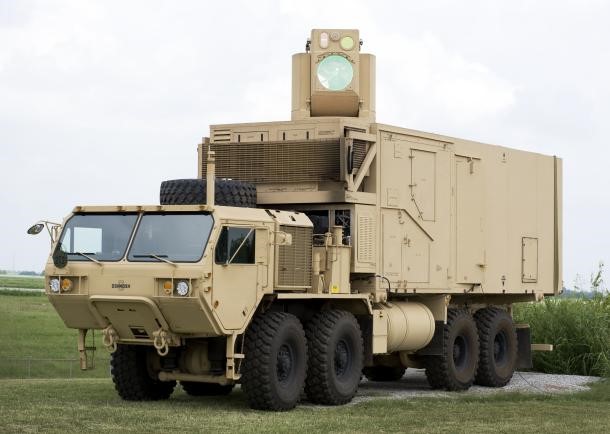
HEL-MD-hires-1024x682

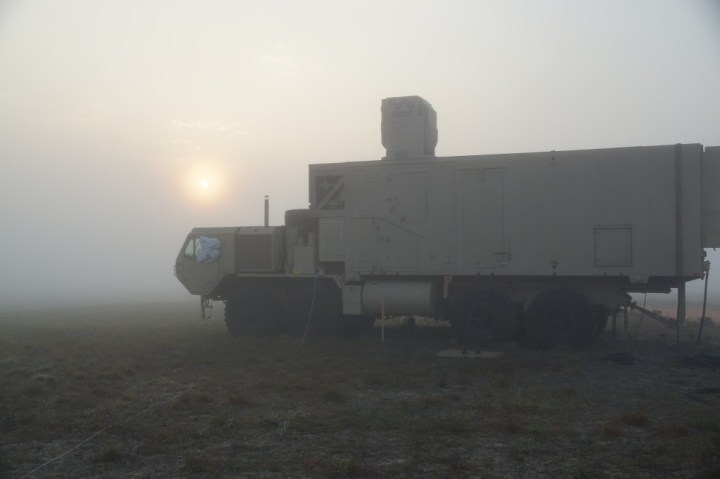
The US High Energy Laser Mobile Demonstrator, successfully used in mid 2014 to destroy drones and 60mm mortars in flight. It’s success was also proven during periods of adverse weather.

But they exist. The operational release of the the 33kW solid state Laser Weapon System, involved the integration of the weapon on the testbed of the Austin-class USNS, USS Ponce. In September 2014, the LaWS was approved as an operational asset, with the commander of USS Ponce having the authority to use it as an offensive weapon. To date it has successfully detonated a rocket propelled grenade, burnt out the engine of a rigid hull inflatable boat and disabling a Scan Eagle UAV.

.

Boeing Laser

 The Boeing HEL MD

.

Laser_Weapon_System_aboard_USS_Ponce_(AFSB(I)-15)_in_November_2014_(05)

The 33kW beam-superimposing fibre-based solid state Laser Weapon System onboard USS Ponce in the Gulf, 2014.

“Laser Weapon System aboard USS Ponce (AFSB(I)-15) in November 2014 (05)” by U.S. Navy photo by John F. Williams – This Image was released by the United States Navy with the ID 141115-N-PO203-057 

The most significant progress in the development of LWS in Europe has been from Germany. Rheinmetall, based in Germany, recently conducted successful sea trials of a 20kW Beam Forming Unit (BFU), integrated with an MGL 27 Naval Gun.

The UK’s Ministry of Defence also made it known in April 2015, of its intent to acquire a Laser Directed Energy Weapon Capability Demonstrator, a programme that is expected to cost in the region of £100m.

Currently, although it is unlikely that we will see major operationally deployed Direct Energy Weapons systems, these prototype weapons, in the early days, will act as force multipliers, extending engagement range and adding magazine depth, until more powerful weapons are developed.

Laser_Weapon_System_control_station_aboard_USS_Ponce_(AFSB(I)-15)_in_November_2014_(02)

The LaWS control station aboard the USS Ponce..

Harvey Black