Military Bulletin 07/2015 – Russian nuclear missile drills.

At the beginning of June, Russia initiated a number of large-scale drills for its Strategic Missile Forces. Fifty regimental and ‘special tactical’ exercises, some lasting more than a month, involving rapid deployment and break-out to field positions will continue, unannounced, throughout the year. This will involve 30 missile regiments along with their associated mobile missile systems.

At least a third of the exercises will be surprise drills, and they will involve combat training with security and defence units. Additional ‘special tactical’ exercises, twenty in total, will also be conducted involving biological warfare defence training. It is thought that ten types of biological weapons and toxic agents will be simulated, including anthrax, plague and Ebola.

imageTopol-M TEL (Transporter, Erector & Launcher), Russian Intercontinental Ballistic Missile. NATO reporting name SS-27 ‘Sickle B’. Speed Mach 22 (26,000+kph), range of 11,000 kilometres, carrying a 800 kiloton warhead.

Below is the SS-27 Mod2, a Russian (Multiple Independently targeted Reentry Vehicle) MIRV-equipped thermonuclear weapon intercontinental ballistic missile. It is believed that it can carry up to 10 MIRVs. At least 4 MIRVs, each carrying 100-300 kiloton warheads. It has a speed of Mach 20 (24,500 kph) and a range of 11,000 kilometres.

.

PC-24_«Ярс»-2

The RS-24 Yars, NATO reporting name of SS-27 MOD

“PC-24 «Ярс»” by Соколрус – Own work. Licensed under CC BY-SA 4.0 via Wikimedia Commons 

This is all part of Moscow extensively testing its ‘triad’ nuclear arsenal, submarine launched ballistic missiles, silo-based intercontinental missiles and its long-range strategic bombers. General Sergei Karakaev, commander roof the Russian Strategic Missile Forces, has been quoted as saying ‘the exercises will guarantee the highest degree of combat readiness and break-out capabilities, and of fighting in different environmental conditions, including an NBC (Nuclear, Biological and Chemical) environment.

The Bear continues to growl…..

Post copyrighted to Harvey Black


Military Bulletin 06/2015 – Soviet Submarine Fleet

There is a lot of talk about the demise of the Russian Submarine Fleet, but one still exists and is still very powerful. Split into Strategic and Tactical, the Russians currently have:

Strategic SSBN

3 x Kalmar (Delta III), each carrying 16 R-29-R Volna (SS-N-18 stingray) strategic Submarine Launched Ballistic Missiles (SLBM)

6 x Delfin (Delta IV), each carrying 16 R-29RMU Sineva (SS-N-23 Skiff) strategic SLBM (One has just returned from repairs)

1 x Akula (Typhoon) in reserve for training with the capacity for 20 Bulava (SS-N-X-32) SLBM. (trials/testing)

2 x Borey with capacity for 16 Bulava (SS-N-X-32) SLBM (missiles not yet operational). One additional vessel expected 2014/2015.

.

K-535_Yuri_Dolgorukiy_at_sea_trials

K-535 Yuri Dolgorukiy, Borey-Class, at sea trials

“K-535 Yuri Dolgorukiy at sea trials” by Schekinov Alexey Victorovich – Own work. Licensed under CC BY-SA 3.0 via Wikimedia Commons 

Tactical

SSGN

8 x Antyey (Oscar II) (of which three are in reserve or repair). each has 2 x 12-cell launcher with 3M45 Granit (SS-N-19 Shipwreck) Submarine Launched Cruise Missile (SLCM) Anti-ship missiles (AShM). 2 single 650mm Torpedo Tubes (TT) each with T-65 HWT. 4 single 553mm TT.

1 x Yasen (Graney) with one Octoupule Vertical Launch System (VLS) with 3M55 Onyx AShM; 3M14 Kalibr (SS-N-30) SLCM; 8 single 533mm TT.

SSN

Russia also has 17 Nuclear attack submarines, SSN, consisting of the following types:

2 x Schuka-B (Akula II)

8 x Schuka-B (Akula I)

2 x Kondor (Sierra II)

1 x Barracuda (Sierra I)

4 x Schuka-B (Victor III)

SSK

The Russian navy has 21 x SSK submarines. 2 x Varshavyanka (Kilo) are under construction along with 2 x Lada (AIP fitted)

The submarines are spread across four major fleets; Northern Fleet, Pacific Fleet, Baltic Fleet and Black Sea Fleet. There is also a Caspian Sea Flotilla.

.

r28353_39_russia_petropavlosk_pleiades_01052013_l-2

Pleiades satellite imagery of Russian Submarines – Petropavlovsk, Russia

Copyright: CNES 2013, Distribution Airbus DS

.

The Russian Navy, according to the State Armaments Programme to 2020, will focus on nuclear-submarine construction in the medium term.There are two key projects; the building of 8 x Borey with capacity for 16 Bulava (SS-N-X-32) SLBM and 7  x Yasen Class multipurpose nuclear powered attack submarines  equipped with cruise missiles.  It is believed that these plans will not be achieved on schedule, based on the difficulties already experienced in building 50 or more major warships. The main armament doesn’t appear to be ready for the Borey-class of submarine, with the failure of the Bulava test launch in September 2014.

The Russian navy is also working on two other special projects, manned by officers only. Project 210 Losharik and Project 09851 khabarovsk. These ‘special purpose’ nuclear submarines are being constructed for use in special operations of an undisclosed nature.

The Bear is still growling…..

Post copyrighted to Harvey Black
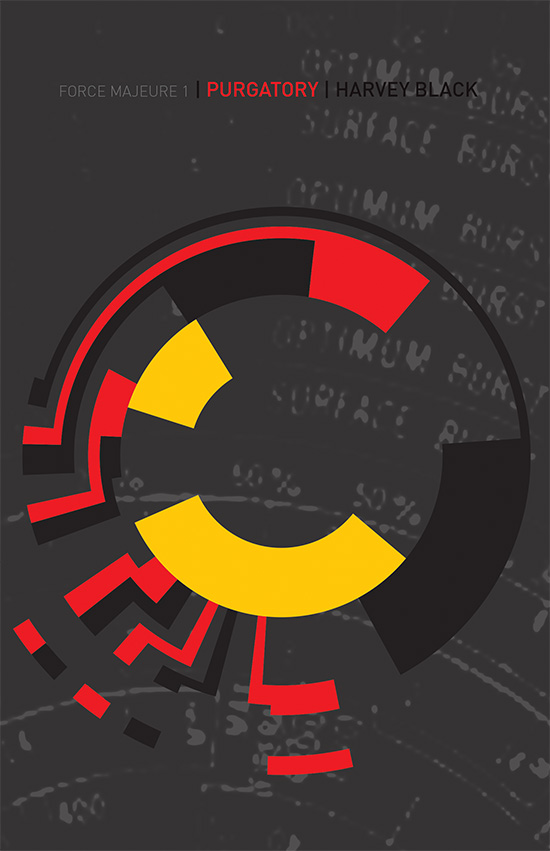
Force Majeure – Purgatory (Editor’s Choice)

The Bookseller -Independent Authors, Editor’s Choice.

Graphic and pacy account of the aftermath of a nuclear strike.

10497332_10204412206400717_3721768951644582128_o

Force Majeure – Purgatory.

9781781323410-Perfect.indd

The first in my new Apocalyptic series, Force Majeure – Purgatory. Due out in mid-March.

Operation_Upshot-Knothole_-_Badger_001

.

Site and content is copyrighted to Harvey Black.


Force Majeure – Purgatory.

9781781323410-Perfect.indd

The first in my new Apocalyptic series, Force Majeure – Purgatory. Due out in mid-March.

.

With the country of Ukraine on the boil, NATO troops move in to support the Ukrainian Prime Minister in defiance of Russia’s continued belligerence. British, US and Polish forces start to dig in along the Russian/Ukrainian border and the temperature rises.

With the Russian economy spiralling downwards, the sanctions starting to bite, and while the rest of Europe debate the level of of involvement they are prepared to commit to, the Russian President’s forces strike.  Attacking from the east and from the south, with forces they had built up in the Crimea, they send NATO reeling.

The German, Dutch and Belgian Governments finally release troops into the fight, recognising the threat the Russian action would have on the stability of the European continent. But too late, by that time the Russian President’s patience ran out, and the button was pushed….

Operation_Upshot-Knothole_-_Badger_001

What would happen if the UK was hit by over 300 megatons of nuclear missiles/bombs? What plans are in place to deal with the aftermath?

The basis of defence planning in the UK during the 90’s and beyond had two key areas of focus:

Miltary

To secure the United Kingdom against any internal threat and to mitigate the effects of any direct attack on the United Kingdom involving the use of conventional, nuclear, biological or chemical weapons.

A direct major military attack on the UK, is likely to be in tandem with a conflict triggered elsewhere in the world. The UK’s involvement in say the Ukraine, helping to defend a potential incursion from Russian forces, would involve British troops digging in on foreign soil. But should Russian troops attack, a potential overspill from the battle could involve strikes against the British mainland. Any aggressor launching a land attack against the UK mainland would not find the task easy. With one of the most modern armies in the world, a navy with its latest warships and hunter killer nuclear submarines and an air force with latest air superiority fighters, any enemy would more than likely regret the day the decision was made. But in respect to a nuclear attack, that would be a totally different ball game…..

Civil

To provide an alternative mechanism of government at all levels to direct national survival; and to enhance the basis for national recovery in the post-attack period.

To cope with the aftermath of a nuclear strike on the UK, Britain’s civil defence was based on a Regional Government structure.

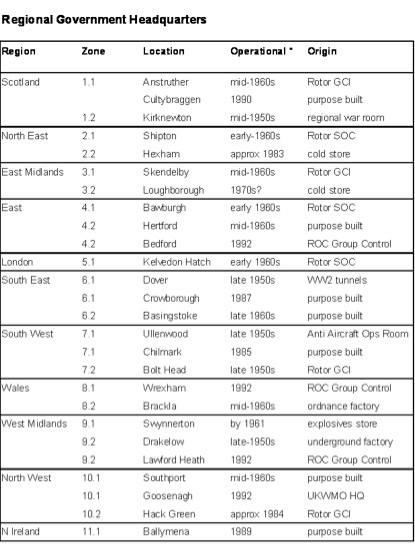
The Regional Government Headquarters were the embodiment of the original regional level structure that began with the joint civil-military HQs in the mid-1950s. Other than the terms used, the number of staff allocated, their primary role had changed little from the late 1950s to the early 1990s.

Although the majority of the Regional Government Centres are no longer supported, it is possible that many could be resurrected in a time of war.

Many of the 1980s RGHQs used buildings which had previously been used as Regional Seats of Government or Sub Regional Controls in the 1960s. The majority though, were refitted in the 1970s or 1980s. During the 1980s, new bunkers were built. The mid-1980s saw the biggest increase in bunker construction since the early 1950s. Hardened facilities were built for army headquarters, communications facilities, fuel supply points, water companies, etc during the decade.

Harvey Black Force Majeure-Purgatory (2).

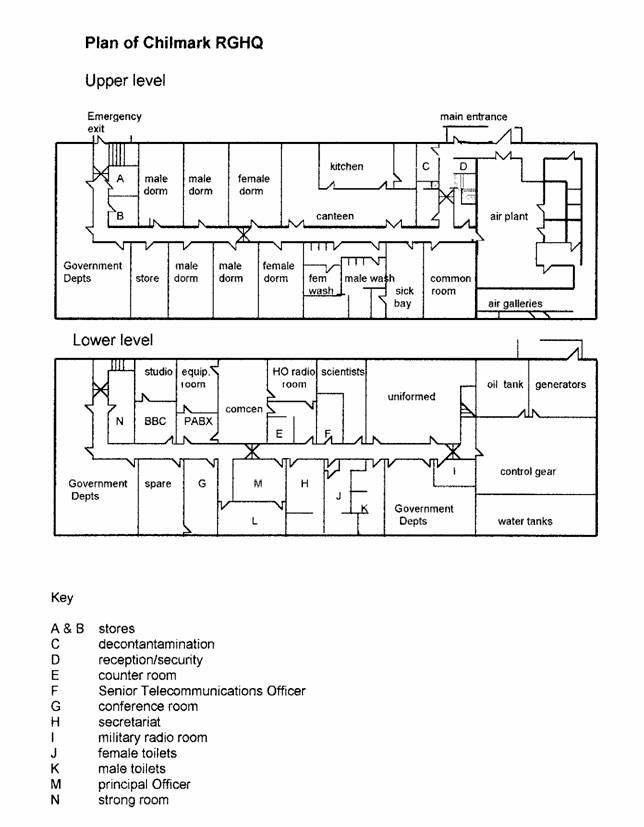
Regional Government Headquarters – Chillmark

Harvey Black Force Majeure-Purgatory (1)

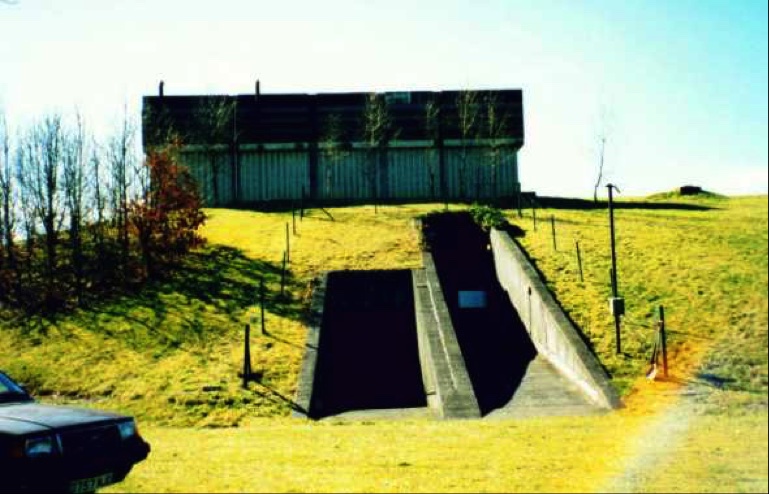
The Chilmark RGHQ.

The Chilmark Regional Government Headquarters served the eastern zone of the Number 7 South Western Home Defence Region, covering the counties of Avon, Wiltshire, Gloucestershire, Somerset and Dorset. It was designated as RGHQ 7.1.

.

Harvey Black Force Majeure-Purgatory (3)

.

Some great additional information can be found at Steve Fox’s, Struggle for Survival, site below.

http://www.subbrit.org.uk/rsg/features/sfs/new_page_1.htm

Site and content is copyrighted to Harvey Black.