A qualified parachutist, Harvey served with British Army Intelligence for over ten years. His experience ranges from covert surveillance in Northern Ireland to operating in Communist East Berlin during the cold war, where he feared for his life after being dragged from his car and attacked by Russian KGB soldiers. Since then he has lived a more sedate life in the private sector as a Director for an International Company, but now enjoys the pleasures of writing. Harvey is married with four children.

Military Bulletin 04/2015 – Directed Energy Systems

Direct Energy Weapons, or High Energy Laser (HEL) weapons systems, are said to offer cost-effective, near-instantaneous precision, at long range against multiple targets. An almost limitless number of shots at a cost of perhaps £1 per round, versus firing a missile, say a Harpoon anti-ship missile, at a cost of of roughly £1,000,000 per unit, with limited number of re-fills on board a ship, DES has to be the sought after option. So, why aren’t they already a key weapon in military arsenals?

The development of HELs is not without reservation or problems. There are percieved operational limitations, driven by the requirement for line-of-sight engagement, tracking of targets at extreme range, optical tracking of targets, the effects of atmosphere and environmental inhibitors and most importantly the ability to destroy a hardened target.

.
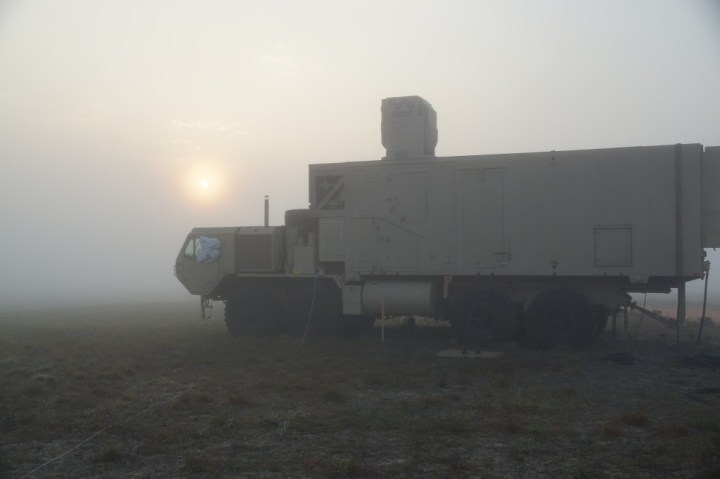
HEL-MD-hires-1024x682

The US High Energy Laser Mobile Demonstrator, successfully used in mid 2014 to destroy drones and 60mm mortars in flight. It’s success was also proven during periods of adverse weather.

But they exist. The operational release of the the 33kW solid state Laser Weapon System, involved the integration of the weapon on the testbed of the Austin-class USNS, USS Ponce. In September 2014, the LaWS was approved as an operational asset, with the commander of USS Ponce having the authority to use it as an offensive weapon. To date it has successfully detonated a rocket propelled grenade, burnt out the engine of a rigid hull inflatable boat and disabling a Scan Eagle UAV.

.
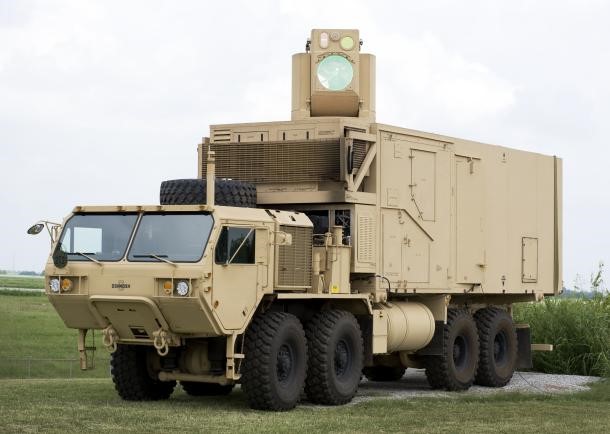
Boeing Laser

 The Boeing HEL MD

.

Laser_Weapon_System_aboard_USS_Ponce_(AFSB(I)-15)_in_November_2014_(05)

The 33kW beam-superimposing fibre-based solid state Laser Weapon System onboard USS Ponce in the Gulf, 2014.

“Laser Weapon System aboard USS Ponce (AFSB(I)-15) in November 2014 (05)” by U.S. Navy photo by John F. Williams – This Image was released by the United States Navy with the ID 141115-N-PO203-057 

The most significant progress in the development of LWS in Europe has been from Germany. Rheinmetall, based in Germany, recently conducted successful sea trials of a 20kW Beam Forming Unit (BFU), integrated with an MGL 27 Naval Gun.

The UK’s Ministry of Defence also made it known in April 2015, of its intent to acquire a Laser Directed Energy Weapon Capability Demonstrator, a programme that is expected to cost in the region of £100m.

Currently, although it is unlikely that we will see major operationally deployed Direct Energy Weapons systems, these prototype weapons, in the early days, will act as force multipliers, extending engagement range and adding magazine depth, until more powerful weapons are developed.

Laser_Weapon_System_control_station_aboard_USS_Ponce_(AFSB(I)-15)_in_November_2014_(02)

The LaWS control station aboard the USS Ponce..

Harvey Black

Military Bulletin 3 – USN surface firepower upgrade

Since the end of the Cold War and the subsequent reduction in the Soviet Union’s own fleet, the United States Navy is without doubt the world’s largest maritime superpower. But a consequence of this, having no credible sea-denial threat, the USN has focussed on power projection from the sea rather than a more broader strategy that includes control of the sea. Vice Admiral Thomas Rowden, commander of US Naval Surface Forces, told a recent symposium, ‘It was a navy that was equally adept at sea control as it was at strike.’  This now needs to be addressed.

One way way of addressing this shortfall, at an acceptable cost, would be a further introduction of Littoral Combat Ships (LCS). The creation of small, fast, manoeuvrable, relatively inexpensive DD class type of ship, with variable roles, supported by changeable mission packages, would go some way to meet this shortfall.

.

Independence_(LCS_2)_in_drydock

In 2014, Independence switched from a mine to surface warfare mode in 96 hours on short notice.

“Independence (LCS 2) in drydock” by U.S. Navy Photo/Released – http://www.navy.mil/view_single.asp?id=67110. Licensed under Public Domain via Wikimedia Commons –

.

One key requirement for the LCS concept, is the need for an ‘over-the-horizon’ surface-to-surface missile.

.

Harpoon_missile_launch_aboard_USS_Shiloh

The current Harpoon Block 1C missile will therefore need to be replaced, with a target date of mid-2020s. A new offensive anti-surface weapon will be required if a satisfactory strike range is to be achieved.

“Harpoon missile launch aboard USS Shiloh” by U.S. Navy photo by Mass Communication Specialist 3rd Class Kevin V. Cunningham/Released) 140915-N-UF697-087 –

.

2014_demonstration_USN

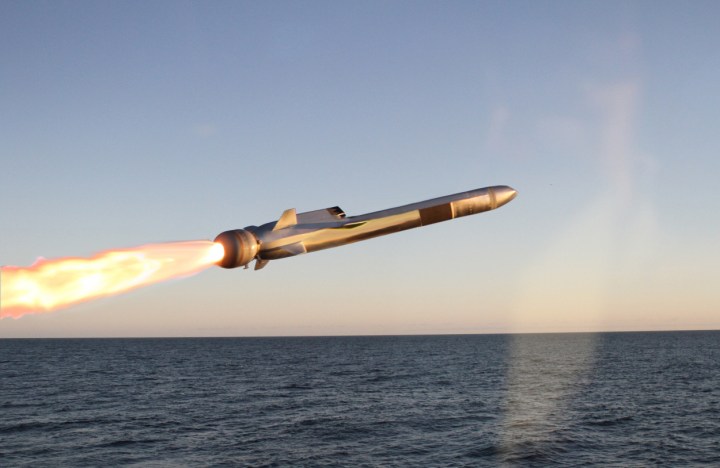
A live fire test of the Kongsberg Naval Strike Missile (NSM) from the USS Coronado in 12014. This provided a demonstration of the potential ‘over-the-horizon’ anti ship capability that could be used by both the LCS and the evolved frigate variant.

.

New-NSM-background

The missile is completely passive and has proven to have excellent sea skimming capabilities. With its advance terminal manoeuvres, it is expected to survive current enemy air defence. The Autonomous Target Recognition (ATR) of the seeker will ensure that the correct target is detected, recognised and hit.

.

Harvey Black

Military Bulletin 2 – USN OHIO SSBN replacement

The United States Navy is getting ready for the replacement of its current 14 Ohio class SSBN nuclear fleet. The plan is for 12 new boats, each one carrying 16 D5 Trident II nuclear missiles. Two successful D-5 missile tests were announced in February, confirming the extended life of the Trident missile. This will no doubt be as equally important to the UK’s future new generation of SSBN submarines for the Trident missile.

The estimated cost will be in the region of $100 Billion, with the lead boat being delivered in 2028.

Harvey Black

.

OHIO_Replacement_Concept_NAVSEA

.


US OHIO replacement concept

“OHIO Replacement Concept NAVSEA” by NAVSEA – NAVSEA. Licensed under Public Domain via Wikimedia Commons –

.

The chosen propulsion system will be an Electric drive, reducing the need for reduction gearing. The nuclear and steam turbines will still be at the heart of the ship’s propulsion system.

.

SSBN-X

 It is proposed that each SSBN would have 16 launch tubes for the Trident II nuclear missile.

.

The USN also plans to share a common missile compartment design with the Royal navy’s proposed replacement for the Vanguard-class SSBNs

.

Ohio_Replacement_Submarine_cutaway_2014_Sea,_Air,_and_Space_Symposium

Cutaway image of the Ohio replacement SSBN

.

“Ohio Replacement Submarine cutaway 2014 Sea, Air, and Space Symposium” by CAPT William J. Brougham, USN – PMS397 Program Manager – NAVSEA – “Document: Ohio Class Replacement 2014 Briefing Slides” – United States Naval Institute News – Published: April 9, 2014 1:31 PM. Licensed under Public Domain via Wikimedia Commons –

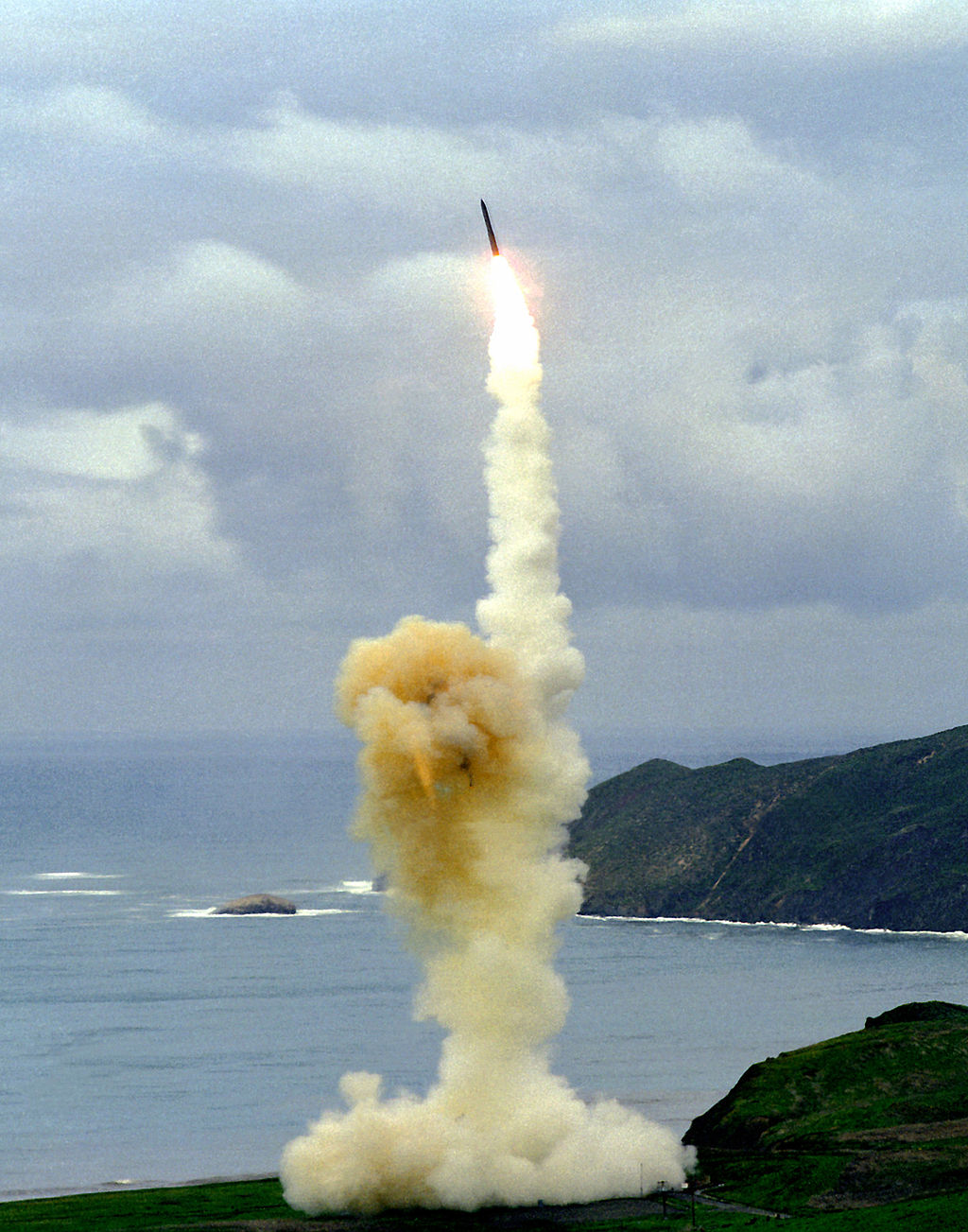
The US Air Force carried out two test launches of unarmed Minutemen III, LGM-30G, intercontinental ballistic missiles over a three day period during March 2015. Both were launched, as part of a systems operational test, from Vandenberg AFB.

These launches are used to verify the performance of the nuclear missile. It is also a reminder of the US’s capability in respect to being able to respond to nuclear threats. A message to Putin as well, perhaps….

Harvey Black

.

1024px-Minuteman3launch-2


Minuteman III, Intercontinental ballistic missile. can carry 12 nuclear warheads 13, 000 kilometres.

“Minuteman3launch”. Licensed under Public Domain via Wikimedia Commons –