The Cold War – Redux (Duplicity) KOBO interview London Book Fair 2016.

A couple of years ago, I wrote a Cold War trilogy, The Red Effect, The Black Effect and The Blue Effect, portraying what I believe could have happened in the 1980’s, had the Soviets, and the Warsaw Pact, taken the decision to attack West Germany and plunged the world into a third world war.

I now ask myself the question, are we heading down that very route now? To answer that, I written the first book in a new Cold War trilogy, or the ‘Cool War’ as it is sometimes referred to. The title is ‘The Cold War – Redux (Duplicity)’.

Where does my story start? I felt the only way to find the answer to that was to go to the very melting pot that could turn the Cool War, into a Hot War, the Ukraine.

Please watch the KOBO interview conducted at the London Book Fair 2016. 8 minutes in. Embarrassing watching yourself on video!

.

The Cold War – Redux (Duplicity) KOBO interview London Book Fair.

8 minutes in for Harvey Black.

.

Flag_of_Ukraine.svg

.

The flag of Ukraine.

.

IMG_2236

T-80, painted in the colours of the Ukrainian Flag,  at the War Museum in Kiev

.

Duplicity-front cover-100dpi

Cold War Redux – Book 1. Duplicity


Military/Intelligence Bulletin 07/2016 – Russia plans new divisions to counter NATO.

Russia plans to create two additional army divisions to counter what it sees as the NATO threat.

.

map-vo-west

Russian Western Military District.


By the end of 2016, Russia is planning on creating two new divisions to counter what it perceives as the growing NATO military might on its borders. These new divisions are in addition to the two announced in January.

.

PARAD_150507_52

Russian T-72B3. Deliveries to the Russian army started in 2012 and continues today. This type of tank has been seen near the Ukrainian border.

One of these newly announced divisions will be created in the Western Military District and the second one in the Southern Military District. The two divisions announced in January will be created in the Central Military District and one in the Western Military District.

The ground forces commander-in-chief, Colonel General Oleg Salyukov, stated that these new divisions will formed from existing brigades. Although Russia abandoned the Soviet-era divisional structure as part of their reforms, due in the main to the chronic shortage of manpower, these divisions will revert to that older structure.

The divisions will likely consist of 10,000 men in six regiments. The worrying thing about these division types, is that they are designed for mass confrontation, as opposed to the brigades which were created to fight localised wars on Russia’s periphery. The Iron curtain is being drawn across the east west borders yet again.

.

Blue – Western Military District

Brown – Southern Military District

Green – Central Military District

Orange – Eastern Military District

.

Post copyrighted to Harvey Black


Military/Intelligence Bulletin 04/2016 – Russian Kornet-D SPATGMs on order.

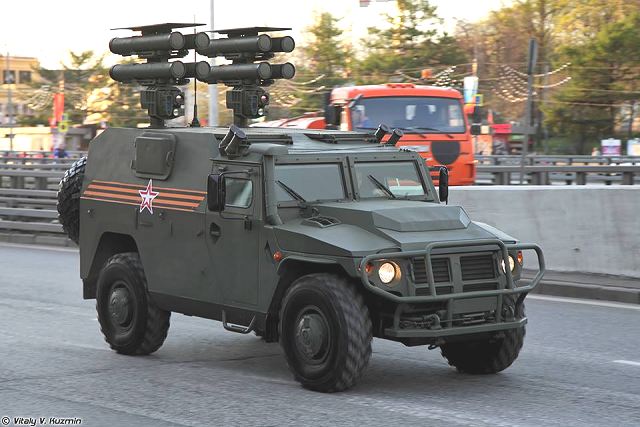
The Russian military has ordered 92 x 9P163-3 Kornet-D, AT-14 Spriggen, a self propelled anti-tank guided missile (SPATGM) system carried on a Gaz-2975 Tigr chassis.

The 4 x 4 Tigr, powered by a Cummins engine, has a top speed of around 130+km per hour.

.

First delivered to the Russian Army in 2006, the Gaz Tigr is a multipurpose, all-terrain infantry mobility vehicle manufactured by Gaz.

Photo By Digr – Ru-Wikipedia, initial image was here, CC BY-SA 3.0

There are a number of variants, some used for Internal security, a command variant, an anti-aircraft command module along with various export models.


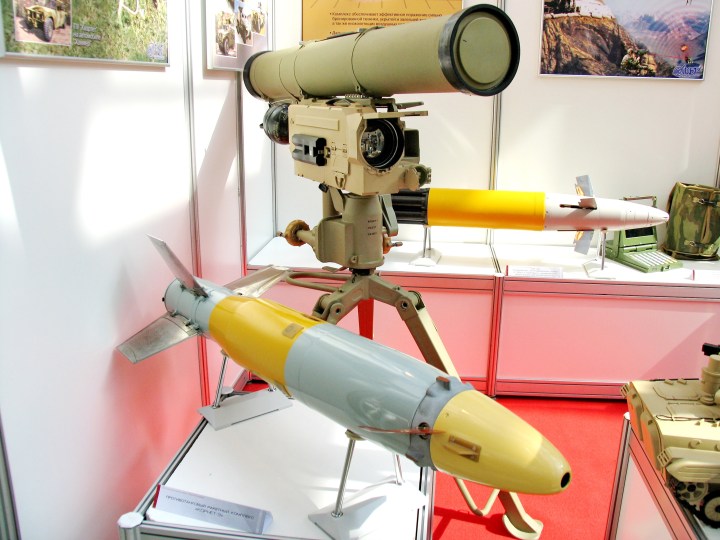
Kornet-D/EM(export model)

Photo By http://www.defensetech.org/archives/images/russian_missile.jpg, CC BY-SA 3.0,

Now, the Russian military has ordered 92 of this latest SPATGM variant. 2015, saw the manufacture of the Tigr-M armoured hull. This two-door Tigr-M chassis is used only for the Kornet-D SPATGM system.

.

9M133 Korne, anti-tank guided missile system.

Photo By Mike1979 Russia – Own work, CC BY-SA 3.0

There are believed to be two versions of the Kornet-D, which will replace the ageing AT-5 (konkurs) and AT-6 Fagot). It made its debut appearance at the 9 May 2015 Victory Day Parade in Moscow.

The Kornet system has two masts, each carrying four 9M133M-3 Kornet missiles and a guidance and sighting unit. This allows for two targets to be engaged at the same time. The masts are fully retractable.

Its range is up to 8,000 metres and the twin warhead can penetrate 1,300mm of rolled homogenous armour behind explosive reactive armour. It is potentially the best in its class.

.

Post copyrighted to Harvey Black


Military/Intelligence Bulletin 03/2016 – Iskander TEL spotted in Syria.

Television footage and satellite imagery has revealed a single Iskander TEL deployed to Humaymim air base, currently the air base used by Russia’s air force in Syria.

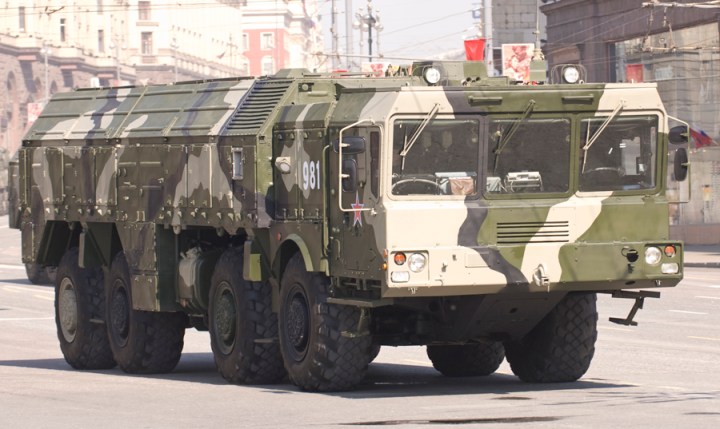
Although it is clear that Russia has deployed an Iskander TEL in Syria, its purpose is as yet undetermined. The SS-26 is a mobile short-range ballistic missile system and is capable of carrying a number of differing warheads, including cluster munitions, fuel-air explosive enhanced-blast warhead, a bunker buster and an EMP, Electro-Magnet Pulse, warhead.

.

9K720 Iskander – SS-26 Stone

Photo By Aleksey Toritsyn – Victory_Day_09_05_2010_Tech, CC BY-SA 3.0,

But on a more ominous note, the SS-26 can also carry nuclear warheads.


Iskander missile in launch position

Photo By http://www.defensetech.org/archives/images/russian_missile.jpg, CC BY-SA 3.0,

.

Iskander missiles right, and an OTR-21 Tochka missile on the left.

Photo By Leonidl – Own work, CC BY-SA 3.0

The range of an Iskander missile is believed to be in the region of 280-500km, although to comply with the INF treaty it would need to be officially less than the 500km. If the one in Syria is an export version, Iskander-E, then the range could be the lower 280km. The TEL chassis is an 8×8 MZKT 79306 ASTROLOG Truck.

The one sighted in Syria is believed to be either an Iskander-M ballistic missile system, or the Iskander-K, the cruise missile system. Why is it there? Consensus is that it has been put there as a warning to countries in the region not to attack Russian aircraft on the ground for fear of retaliation, or replace the role of the strike aircraft that have been withdrawn form the country. Perhaps it is there to target Patriot batteries based in Turkey, although at the moment the Spanish Patriot PAC-2 battery at Adan airport is too far from the border to threaten aircraft in Syrian airspace.

.

Post copyrighted to Harvey Black