Military/Intelligence Bulletin 08/2016 – Russian Roulette.

Red Alert! Is the upgrading of the Russian Federation’s armed forces and the various International deployments indicating a return to the Cold War of old?

So where are the Russian forces currently deployed?

.

Kaliningrad base

Kaliningrad.

Kaliningrad

Kaliningrad, part of the Western Military District, is strategically placed. With Poland to the south and southwest, Belarus to the southeast and Lithuania to the east, the Kaliningrad Defensive Area plays a key role in countering the US missile defence system in Europe and places Russian forces directly behind the three Baltic countries of Estonia, Latvia and Lithuania.

The forces in situ are significant – Voronezh DM early-warning radar, 25th Coastal Missile Regiment, 336th Naval Infantry Brigade, 244th Artillery Brigade, 3rd Aerospace Defence Brigade, 79th Motor Rifle Brigade, 7th Motor Rifle Brigade and the 152nd Missile Brigade. There are also three Aviation Groups (Helicopters, transport aircraft, bombers and fighters) along with naval surface forces.

.

Crimea, a region of Ukraine of its southern coast.

Crimea

It is common knowledge that the Russian Federation has reinforced Crimea, threatening the underbelly of mainland Ukraine. The minimum Russian forces in situ late 2015/early 2016 are as follows:

126th Naval Infantry Brigade (formerly Ukrainian forces, but now incorporated into the Russian military), 810th Naval Infantry Brigade, 127th Independent Recce Brigade, 219th Independent EW Regiment, 1096th SAM Regiment, 15th Coastal Missile Brigade, 1 battalion from 11th Anti-ship missile Brigade, 31st Air Defence Division and the 8th Artillery Regiment. They are supported by helicopters from 318th Mixed Aviation Regiment and the 38th Fighter Regiment. For naval forces, the Black Sea Fleet has the 11th ASW Ship Brigade, 41st Missile Boat Brigade, 197th Landing Ship Brigade and the 68th Area Protection Ship Brigade.

Russian equipment newly deployed to Crimea, consists of:

T-72B3 Main Battle Tanks, BTR-82A, Su-30SM Flanker (FGA), SU27SM Flanker (FGA), SA-20 Gargoyle SAM, K-300P Bastion (SSC-5-Stooge Anti-ship missiles) and 3K60 Bal (SSC-6 Sennight Anti-ship missiles).

More forces are believed to be on their way.

.

Transdniester, a partially recognised country between the River Dniester

and the eastern Moldovam border with Ukraine

Transdniester

A country few people are aware of. It is a constant threat to peace in Moldova and has at least 1,500 Russian military deployed there. 2 Motor Rifle battalions with approximately 100 MBTs/AIFVs/APCs. there are also 7 Mi-24 Hind and 8 Mi-8 Hip helicopters.

Again, these forces are ideally positioned, particularly if reinforced, to create havoc, supporting any attack on Ukraine.

Arctic

Not forgetting the Russian Arctic Joint Strategic Command, ensuring Russian military presence in polar waters.

There are Russian, and Russian backed pro-Russian separatists, forces in Ukraine itself. I will cover those in a later Post. Also Central Asia, Caucasus, Syria and the Black Sea.

Post copyrighted to Harvey Black


Military/Intelligence Bulletin 07/2016 – Russia plans new divisions to counter NATO.

Russia plans to create two additional army divisions to counter what it sees as the NATO threat.

.

map-vo-west

Russian Western Military District.


By the end of 2016, Russia is planning on creating two new divisions to counter what it perceives as the growing NATO military might on its borders. These new divisions are in addition to the two announced in January.

.

PARAD_150507_52

Russian T-72B3. Deliveries to the Russian army started in 2012 and continues today. This type of tank has been seen near the Ukrainian border.

One of these newly announced divisions will be created in the Western Military District and the second one in the Southern Military District. The two divisions announced in January will be created in the Central Military District and one in the Western Military District.

The ground forces commander-in-chief, Colonel General Oleg Salyukov, stated that these new divisions will formed from existing brigades. Although Russia abandoned the Soviet-era divisional structure as part of their reforms, due in the main to the chronic shortage of manpower, these divisions will revert to that older structure.

The divisions will likely consist of 10,000 men in six regiments. The worrying thing about these division types, is that they are designed for mass confrontation, as opposed to the brigades which were created to fight localised wars on Russia’s periphery. The Iron curtain is being drawn across the east west borders yet again.

.

Blue – Western Military District

Brown – Southern Military District

Green – Central Military District

Orange – Eastern Military District

.

Post copyrighted to Harvey Black

Military/Intelligence Bulletin 06/2016 – Ukraine develops Mi-8 helicopter Upgrade.

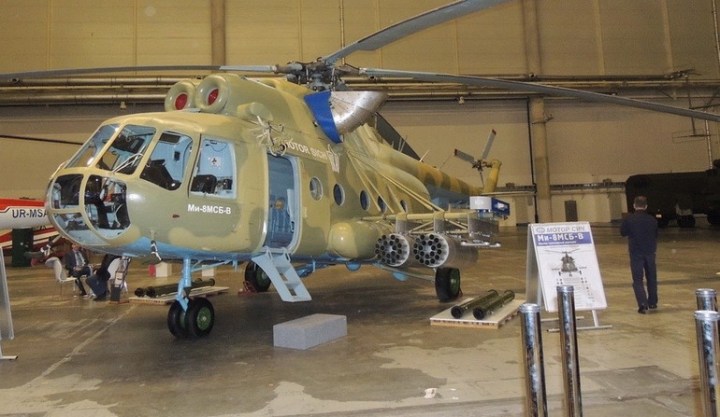
Ukraine’s Motor Sich is developing a number of multirole variants of MI-8MSB-V/W multirole to be employed against the pro-Russian separatist militants.

.

Mi-8 MSB-V/W, multirole helicopter.

.

They are aimed at addressing the threats posed by anti-aircraft systems held by the pro-Russian separatists in the contested eastern region of Ukraine.

Based on the MI-8T helicopter, the aim of the upgrade is to increase firepower and survivability, with the installation of an Adron SKZ-8V digital armament control system and a range of air-to-surface weapons including the GKKB Luch Baryer-V and Russian made Shturm-V anti-tank missiles, taken from existing MI-24 attack helicopter ordnance. Additional armour will  also be provided for the protection of the cockpit and Adron’s Adros ASH-01V infrared suppression systems for its engine exhaust ducts.

.

MI-2MSB-V/W (nearest) and MI-8MSB-V/W at the Kiev military equipment expo. Photo from Motor-Sich company

There will be three MSB-V/W variants:

Version-1 an assault and attack helicopter fitted with a navigation system, electro-optic turret, laser warning receivers, radar, anti-aircraft missiles and grenade launcher pods.

Version-2 a patrol and reconnaissance helicopter similar to version 1, although it won’t be armed with anti-tank guided missiles. But, it will have pylon-mounted launchers for small UAVs, unmanned aerial vehicles.

Version-3 will be an airborne commands and control variant

All variants will have the new TV3-117VMA-SBM1V engine. They will have greater range and a higher ceiling.

.

Photo MI-8MSB-V/W transport/assault helicopter at the Kiev military equipment expo. Photo from Motor-Sich company.

.

Post copyrighted to Harvey Black

Military/Intelligence Bulletin 05/2016 – Islamic State plans further attacks on European cities.

Following threats issued by video and using historical data and proxy attack indicators, it is clear that European cities are far from safe from further attacks by the Islamic State.

.

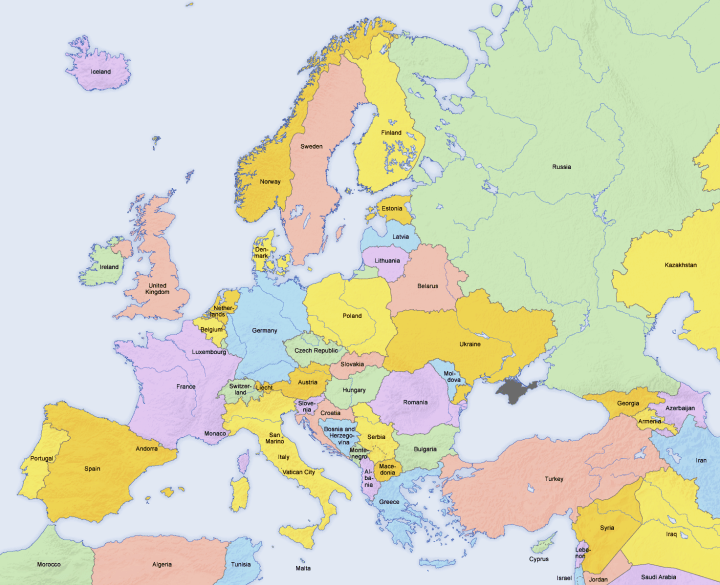
Map of Europe.

By San Jose (map), Hayden120 (retouch) – Derivative work of Europe countries map en.png by San Jose, based on the Generic Mapping Tools and ETOPO2, CC BY-SA 3.0

.

Which of our European cities are under the greatest threat?

The top 13 cities most at risk are considered to be the following:

In order of risk – Paris, Toulouse, London, Brussels, Copenhagen, Lyon, Frankfurt, Marseille, Strasbourg, Berlin, Stockholm, Vienna and Milan.

It is believed that firearms, rather than explosives, would more likely be used in any mass-casualty attacks. This hasn’t been the case so far, with simultaneous shootings and suicide bombings in paris on the 13 November 2015, where 128 people were killed and 352 injured. This was followed by attacks on Brussels’ airport and underground train network.

.

Still from security CCTV footage showing three of the suspects at the Brussels airport.

This continuing threat from the Islamic State had been highlighted by the group itself, when they released two videos at the end of January. The videos depicted the usual beheadings, the first with explicit threats made against the UK. The second one released at the end of January, executions of so called spies were executed by gunshot. This time threats were made against Spain and Portugal.

The type of attack that concerns most European authorities, is a co-ordinated series of mass shootings of the kind witnessed in Paris. An even bigger fear, is the taking of a significant number of hostages.

Multi-phased attacks are expected, potentially gearing up for mid-2016. One potential target could be the Euro 2016 football championship. This will be hosted by France between 10 June and 10 July, at stadia in nine French cities.

Vigilance is the watchword….

.

Post copyrighted to Harvey Black